B.Sc. in Physics
Program Profile
The Physics Department was established within the College of Science in 1997. Its first and main academic programme is the Bachelor of Science in Physics, and the programme welcomed its first cohort of students in 1997.
The programme is designed and regularly reviewed to meet the current and future needs of the Kurdistan Region and Iraq for qualified physicists, educators, and researchers. The curriculum follows international academic standards and provides a strong and balanced foundation in both theoretical and experimental physics. Laboratory sessions further enhance students’ practical skills, analytical thinking, and their ability to apply physical principles to solve real-world problems.
The graduation project represents a major component of the programme, encouraging scientific investigation, critical thinking, and effective teamwork. Internships offer students valuable opportunities to apply their knowledge in practical or research environments. These internships strengthen connections with industry, research centres, and educational institutions, while also helping academic staff remain engaged with community needs that can be addressed through students’ research projects.
Additionally, the programme includes a variety of elective courses, allowing students to tailor their studies to their interests and to the evolving demands of the job market, such as advanced topics in modern physics, computational physics, materials science, and applied physics.
Occupational profiles of graduates
Graduates of this programme are equipped with a strong foundation in fundamental and applied physics. Their analytical thinking, quantitative skills, experimental experience, and ability to model real-world phenomena prepare them for diverse careers in industry, education, research, and technology. They are well-positioned to adapt to evolving scientific and technological challenges.
Typical roles for graduates include:
- Physicist / Research Scientist:
Conducting theoretical or experimental research in areas such as materials science, nuclear physics, optics, nanotechnology, and environmental physics.
- Laboratory Technician / Experimental Specialist:
Supporting and managing laboratory operations, performing measurements, maintaining instruments, and ensuring accurate data collection and analysis.
- Medical Physics Assistant / Radiation Safety Officer:
Assisting in medical imaging, radiation therapy, and radiation protection in hospitals and healthcare institutions.
- Science and Physics Teacher:
Teaching physics and general science at secondary or preparatory school levels and contributing to science education.
- Data Analyst / Computational Modeler:
Applying mathematical and computational methods to analyse data, simulate physical systems, and solve complex technical problems in various sectors.
- Renewable Energy and Environmental Specialist:
Working on energy systems, environmental monitoring, and sustainability solutions involving solar energy, atmospheric studies, and pollution control.
- Technical Consultant / Scientific Advisor:
Providing expertise to industry or government sectors, supporting product development, quality control, and scientific decision-making.
Qualification awarded
Bachelor of Science in Physics
Length of programme
4 years (8 semesters)
Number of credits
240 ECTS credits
Mode of Study
Full time on campus
Read more about the programme
Get detailed information about the programme requirements, courses, credits, and educational objectives as a PDF file.
Program Educational Objectives (PEOs)
The Geology department (Geo) sets Program Educational Objectives (POEs) to prepare graduates who will:
The Program Educational Objectives (POEs) of the Physics department are to prepare graduates who will:
- Equip graduates with solid knowledge of theoretical and applied physics.
- Develop strong analytical, experimental, and problem-solving skills.
- Prepare students for research and professional careers in physics and related fields.
- Foster ethical awareness and commitment to lifelong learning.
- Emplybetefy
Program Learning Outcomes
After successfully completing this programme, students should have:
- Communicate physics knowledge clearly in oral and written forms.
- Apply fundamental principles and laws of physics in practical contexts.
- Use appropriate mathematical techniques in analyzing physical phenomena.
- Design, conduct, and interpret experiments in physics.
- Utilize software tools and simulations in solving physics problems.
- Demonstrate understanding of the ethical and societal aspects of physics.
- Work effectively as a team member or leader in scientific activities.
- Pursue independent learning and keep up with advances in physics.
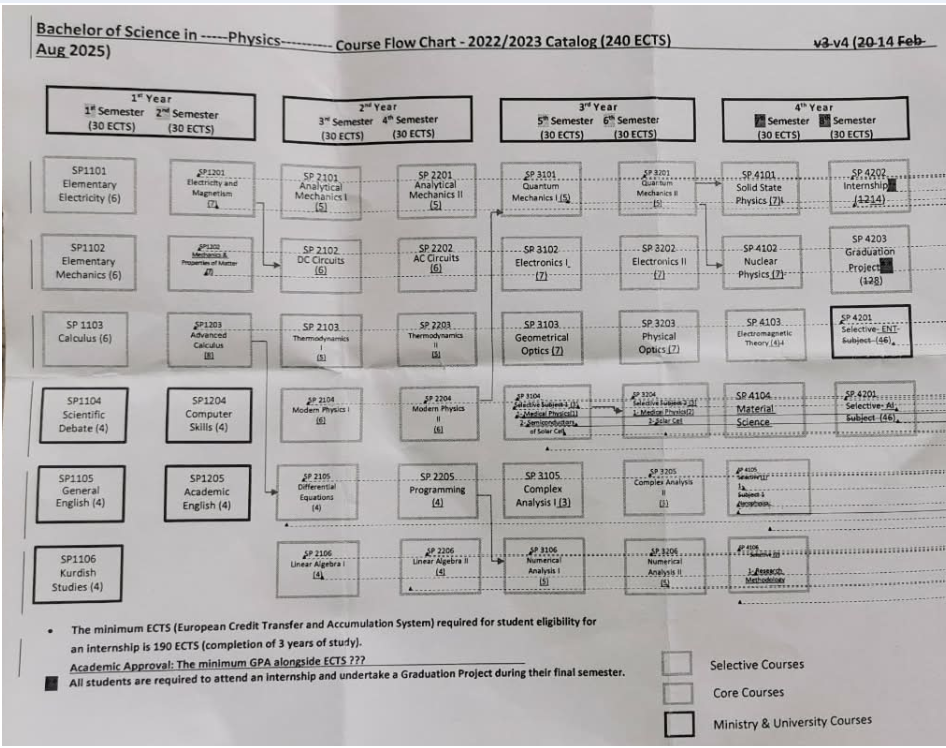
Programme structure diagram with credits
Yearly Timeline
Sept. 1, 2026
⚠️ First year students start around mid-October
⚠️ First year students start exams around 20 of January
July 1, 2027
Check out the full academic calendar on UoD's webstie.
Programme Coordinator

Nuclear physics
Physics
College of Science
University of Duhok
Apply to the Programme
Public undergraduate admissions in the KRG region are managed centrally by the Ministry of Higher Education through the online ZankoLine portal (regayzanko.com). After Grade 12 Baccalaureate results are released, high schools provide students with unique login credentials to rank their preferred universities and B.Sc. majors during a 10–14 day registration window. Final placement is automatically determined by the student's Grade 12 average, subject choices, and department capacity.