WORKSHOP European Credit Transfer and Accumulation System (ECTS)
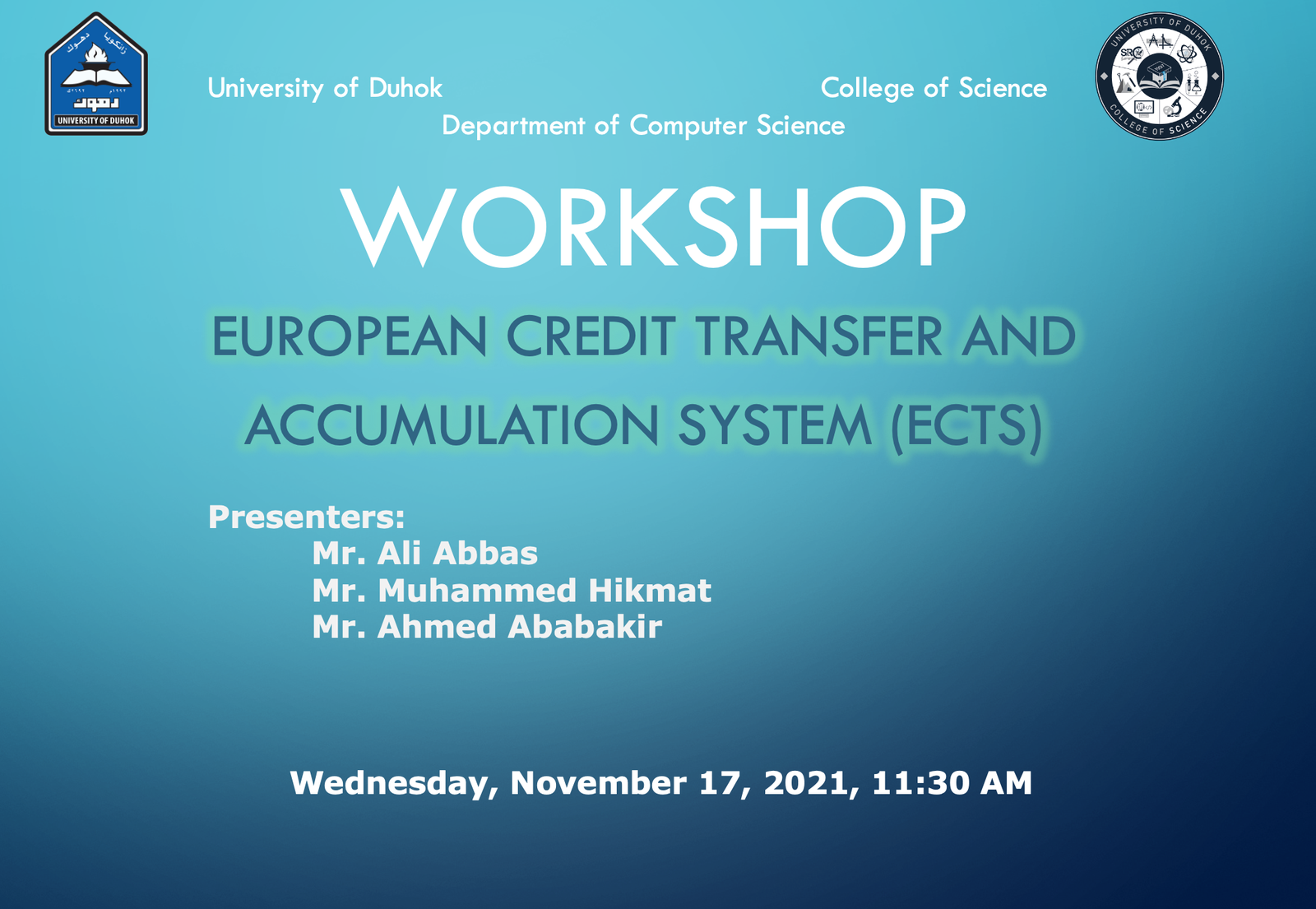
The College of Science and the Department of Computer Science are delighted to invite you to a WORKSHOP entitled:
“European Credit Transfer and Accumulation System (ECTS)”
Place of the event: Lab #5, Computer Science Department, College of Science building, UoD Duhok campus
Date and Time of the event: on Wednesday, November 17, 2021, 11:30 AM
Workshop Presenters
Mr. Ali Abbas
Mr. Muhammed Hikmat
Mr. Ahmed Ababakir
Description:
European Credit Transfer and Accumulation System
The European Credit Transfer and Accumulation System (ECTS) is a tool of the European Higher Education Area for making studies and courses more transparent. It helps students to move between countries and to have their academic qualifications and study periods abroad recognised.
ECTS allows credits taken at one higher education institution to be counted towards a qualification studied for at another. ECTS credits represent learning based on defined learning outcomes and their associated workload.
ECTS enhances the flexibility of study programmes for students. It also supports the planning, delivery and evaluation of higher education programmes. It is a central tool in the Bologna Process, which aims to make national education systems more comparable internationally.
ECTS also helps make other documents, such as the Diploma Supplement, clearer and easier to use in different countries.
ECTS has been adopted by most of the countries in the European Higher Education Area as the national credit system and is increasingly used elsewhere.
Why is ECTS needed?
Differences between national higher education systems can lead to problems concerning the recognition of qualifications and mobility periods abroad. This issue is addressed in part by enhancing the comprehension of the learning outcomes and workload of programmes of study.
ECTS also makes it possible to blend different learning styles, such as university and work-based learning, within the same programme of study or through lifelong learning.
How does it work?
60 ECTS credits are the equivalent of a full year of study or work. In a standard academic year, these credits are usually broken down into several smaller modules. A typical 'short cycle qualification' typically includes 90-120 ECTS credits. A ‘first cycle’ (or bachelor's) degree consists of either 180 or 240 ECTS credits.
Usually, a ‘second cycle’ (or master's) degree equates to 90 or 120 ECTS credits. The use of the ECTS at the ‘third cycle’, or PhD level, varies.
ECTS is applied to support student mobility between higher education institutions. The course catalogues, Learning Agreements and Transcripts of Records help the recognition and transfer of credits earned by students during a mobility period abroad. The ECTS Users' Guide describes the system and how it is used in greater detail.
Objective:
The workshop aims to develop a clear idea of the ESCTS tool for the teaching staff of the department and familiarize them with a part of the Bologna process in advance.
Timeline
|
No |
Starting date |
Ending date |
Time |
Number of participants |
Subject |
|
1 |
Wednesday, Nov. 17th, 2021 |
Wednesday, Nov. 17th, 2021 |
11:30 AM |
20-22 max |
European Credit Transfer and Accumulation System (ECTS) |